- All
- Product Name
- Product Keyword
- Product Model
- Product Summary
- Product Description
- Multi Field Search

Views: 0 Author: Site Editor Publish Time: 2026-05-19 Origin: Site
In the modern hospitality industry, interior materials are no longer selected purely for decoration. For hotel developers, operators, and investors, materials must simultaneously meet requirements for aesthetics, durability, safety, installation efficiency, maintenance cost control, and sustainability. Among various ceiling solutions available today, WPC ceilings (Wood Plastic Composite ceilings) are increasingly recognized as one of the most practical and future-oriented choices for hotel projects worldwide.
From new hotel construction to large-scale renovation projects, WPC ceilings offer a unique balance between performance and cost, making them especially suitable for hotels operating in diverse climates and under intensive daily use. This article provides a comprehensive, professional analysis of the advantages of using WPC ceiling in hotels, from an engineering and B2B project perspective.
A WPC ceiling is manufactured using a composite formula that combines wood fiber or wood powder, thermoplastic resin (such as PVC, PE, or PP), and various additives that enhance strength, stability, fire resistance, and weather performance. The material is formed through extrusion, resulting in panels with uniform structure and reliable quality.
Hotel projects differ significantly from residential interiors. They require materials that can withstand:
Continuous operation with no downtime
High guest turnover
Frequent cleaning and maintenance
Long-term exposure to air conditioning systems
Strict building and fire regulations
WPC ceilings are specifically designed to address these conditions.
Compared with gypsum ceilings, WPC ceilings are more moisture-resistant and impact-resistant. Compared with metal ceilings, they provide a warmer and more welcoming visual effect. Compared with natural wood ceilings, they eliminate issues such as cracking, warping, insect damage, and unstable quality.
This makes WPC ceilings highly suitable for:
Guest rooms and suites
Corridors and elevator lobbies
Hotel lobbies and reception areas
Restaurants, bars, and lounges
Conference and banquet halls
SPA, wellness, and semi-outdoor spaces
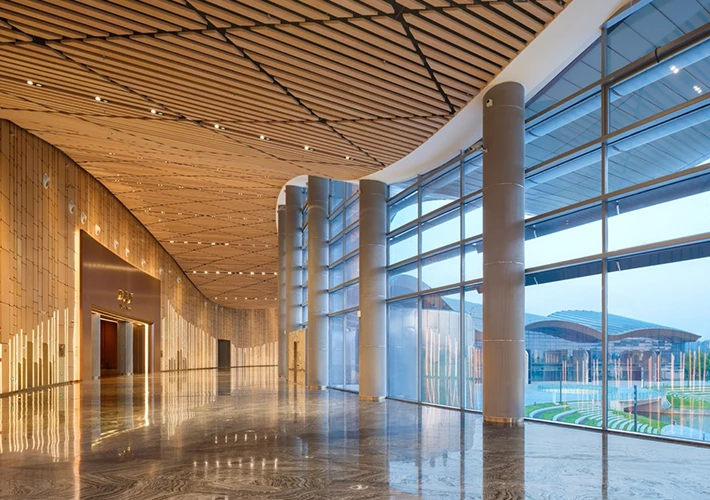
In hotel interiors, ceilings strongly influence the sense of height, warmth, and overall quality. A well-designed ceiling can make a standard room feel premium, while a poorly chosen material can lower the perceived value of the entire space.
WPC ceilings offer:
Realistic wood grain appearance
Uniform color consistency across large areas
Clean lines suitable for modern hotel design
With surface technologies such as 3D embossing, film lamination, UV coating, and co-extrusion, WPC ceilings can closely replicate natural wood while maintaining industrial-level consistency.
Hotels across different market segments have different design needs:
Luxury hotels focus on warmth, texture, and sophisticated lighting
Business hotels prefer minimalist, clean, and professional interiors
Resort hotels emphasize natural materials and relaxing atmospheres
Budget hotels seek cost efficiency without sacrificing appearance
WPC ceilings can be supplied in various colors, panel widths, and profiles, allowing designers to adapt one material system to multiple hotel concepts.
Modern hotel ceilings must integrate lighting, HVAC outlets, sprinklers, and inspection openings. WPC ceiling systems are compatible with:
Linear LED lighting
Concealed light troughs
Modular access panels
This flexibility reduces design conflicts and improves overall construction coordination.
Humidity is one of the most common causes of ceiling failure in hotels. Moist air from showers, kitchens, SPAs, and cleaning processes can easily damage traditional materials.
WPC ceilings are highly resistant to moisture and do not absorb water like wood or gypsum. Even in coastal or tropical regions, they maintain:
Stable dimensions
Flat surfaces
Secure installation
This performance is critical for hotels that aim to minimize operational disruptions.
Hotels experience frequent physical impact from luggage, maintenance equipment, and renovation work. WPC ceilings are stronger and more impact-resistant than many traditional ceiling materials, reducing visible damage over time.
They also offer:
No termite or insect damage
No rust or corrosion
Consistent performance over long service life
Fire protection is a mandatory requirement for hotel interiors. Many WPC ceiling products are manufactured with fire-retardant additives, enabling them to meet international fire safety standards commonly required in hotel projects.
This provides:
Better flame resistance
Lower risk during emergencies
Easier approval during inspections
For hotel brands, fire-compliant materials help reduce legal and operational risks.
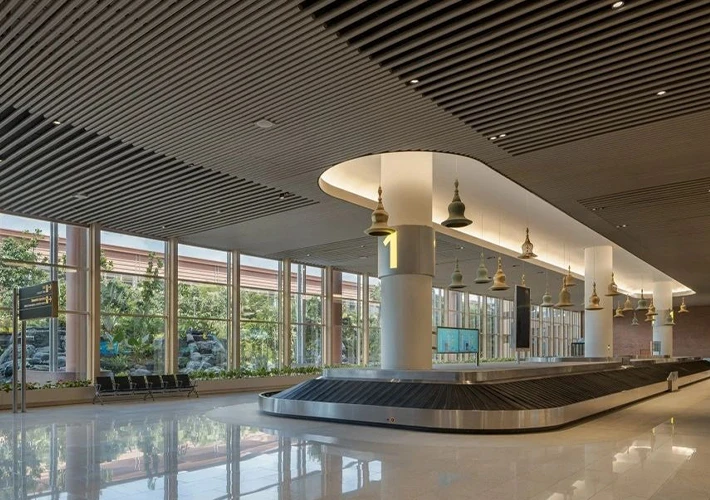
Hotel projects are often under strict timelines. Delays in interior finishing directly affect opening dates and revenue generation.
WPC ceiling systems are designed for fast installation:
Lightweight panels reduce handling effort
Interlocking or tongue-and-groove structures simplify assembly
Less wet work compared with traditional ceilings
This significantly shortens installation time, especially in large-scale hotel developments.
In many regions, skilled labor costs are extremely high. WPC ceilings reduce dependence on specialized labor, making them ideal for overseas hotel projects where labor availability is limited.
Hotel ceilings must remain clean with minimal effort. WPC ceilings feature smooth, sealed surfaces that:
Resist stains and moisture
Are easy to wipe and clean
Do not require repainting
Over time, this reduces housekeeping workload and maintenance expenses.
From a project budgeting perspective, WPC ceilings provide a competitive solution. While they may cost more than basic gypsum boards, they are far more economical than natural wood ceilings and many custom metal systems.
For large hotel projects, WPC ceilings offer:
Stable pricing
Scalable production
Reduced material waste
The true value of WPC ceilings becomes evident over time. Their durability and low maintenance requirements significantly reduce:
Repair frequency
Replacement costs
Operational interruptions
For hotel owners and investors, this translates into better long-term ROI and predictable operating expenses.
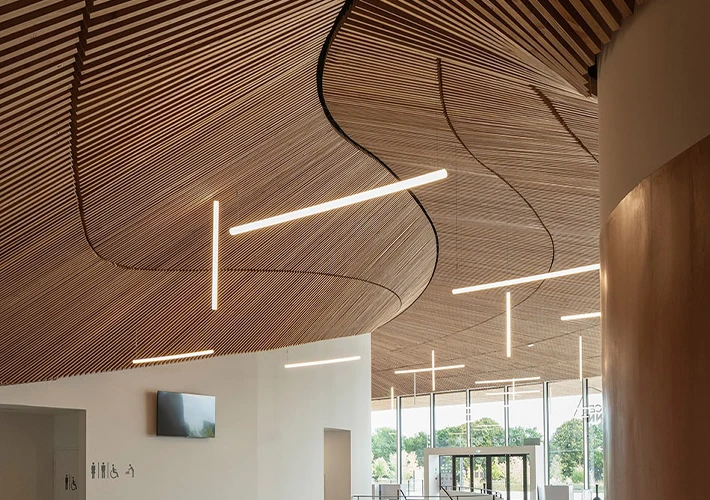
Sustainability is increasingly important for global hotel brands. WPC ceilings contribute to environmental goals by:
Reducing the use of natural timber
Utilizing recycled materials
Offering long service life, reducing waste
High-quality WPC ceilings also meet low VOC emission standards, improving indoor air quality for guests and staff.
Hotels often require consistent interior design across multiple properties. WPC ceilings support customization in:
Color matching
Panel dimensions
Surface finishes
This allows hotel groups to maintain a unified brand image while adapting to local project requirements.
China has become a major manufacturing base for WPC ceiling systems. Professional Chinese factories provide:
Large production capacity
Stable quality control systems
Export-ready packaging
OEM and project-based solutions
This makes WPC ceilings a reliable choice for international hotel developers, contractors, and wholesalers.
The advantages of using WPC ceiling in hotels are comprehensive and practical. From design flexibility and durability to moisture resistance, fire safety, installation efficiency, and long-term cost control, WPC ceilings address the real challenges faced by modern hotel projects.
For hotel developers, architects, contractors, and procurement teams seeking a ceiling system that combines aesthetic appeal, engineering performance, and commercial efficiency, WPC ceilings represent a proven and future-ready solution.
As the hospitality industry continues to evolve toward faster construction, higher sustainability standards, and better operational efficiency, WPC ceilings are set to remain a key material choice in hotel interior design worldwide.


